 KALU AUDIO
Lucerna
The smooth, program-dependent compression of a classic optical leveler, simulated from the physics of the cell itself: a glowing panel, a photoresistor and real tube stages behind them.
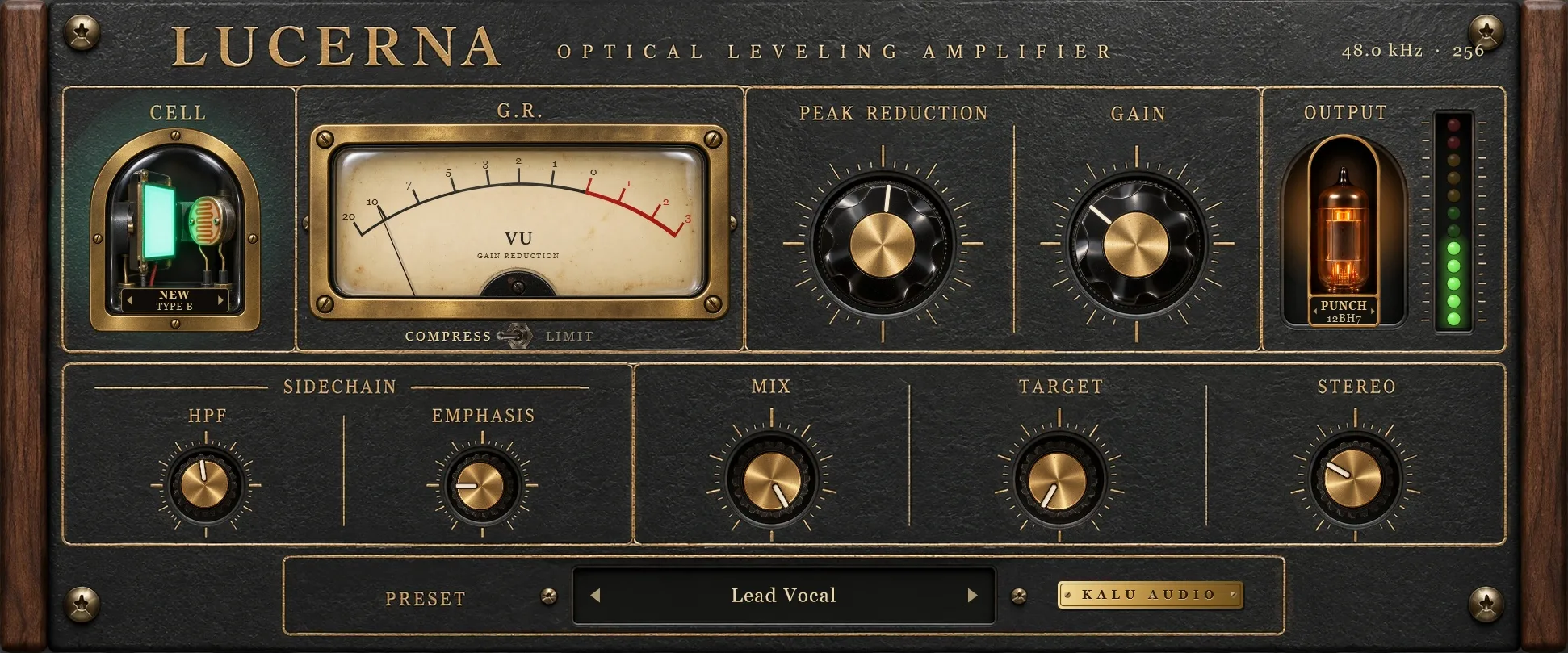
The light is the compression
Inside the window, an electroluminescent panel glows with the signal and shines on a photoresistor. The brighter it gets, the more the cell turns the level down. What you see is what's happening.

A cell that remembers
Optical compressors are loved for a release no knob can set: it depends on what the music just did. Lucerna gets it the honest way, by simulating the cell.
Light in, gain down
The sidechain drives an electroluminescent panel. Its light rises steeply with voltage, and saturates when pushed hard, just like the phosphor in the original cells. Facing it, a cadmium-sulphide photoresistor shunts the audio to ground: the more light it gets, the lower its resistance and the more the signal is attenuated.
- Sidechain
- →
- EL panel
- →
- Light
- →
- Photoresistor
- →
- Attenuation
Two kinds of memory
Free carriers in the photoresistor follow the light within milliseconds: they set the attack and the first, quick part of the release.
Trapped carriers only build up under sustained light, and drain slowly. After a short peak the cell lets go in a fraction of a second; after a long, loud passage it takes seconds. That's the famous two-stage, program-dependent release.
Light history: a cell that has been lit for a while stays slower for a while, as real cells do.
A feedback design
Like the classic leveling amplifiers, the sidechain listens to the cell's output. There is no ratio knob: the ratio rises gently with level, around 2.4:1 in COMPRESS and 5:1 in LIMIT.
Measured, not promised
Attack after a 12 dB jump in level, and the time to give back half (and 90%) of the gain reduction, after a short peak and after 8 seconds of compression. Measured in the plugin.
| Cell | Attack | Release after a peak | Release after 8 s |
|---|---|---|---|
| NEWTYPE B | 9 ms | 74 ms / 2.0 s | 0.75 s / 5.7 s |
| AGEDTYPE B | 14 ms | 194 ms / 4.9 s | 1.9 s / 10.7 s |
| EARLYTYPE A | 21 ms | 208 ms / 5.6 s | 3.0 s / 14.1 s |
| FASTMODERN | 2.5 ms | 32 ms / 0.47 s | 39 ms / 0.93 s |
Release shown as 50% / 90% recovered. For reference, the classic 1960s optical leveler is specified at about 10 ms attack, about 60 ms for the first half of the release and 1 to 15 seconds in total. Before launch, the NEW cell is being checked against recordings of a vintage hardware unit.
Then, real tubes
After the cell comes the same tube model behind Triodia: a 12AX7 driver, an output tube you can choose and an output transformer, all computed from the tubes' electrical equations and run at double rate to avoid aliasing.
Pick the cell, not just the settings
Real cells differ, and engineers swap them to change the character of their units. Lucerna's four cells are modeled on the kinds found in classic levelers, and you swap them with one click.
The reference: a fresh cell. Quick grab, a fast first release and a smooth tail.
Attack 9 ms · release 74 msAn aged cell: slower and lazier, it holds on longer after loud passages.
Attack 14 ms · release 194 msThe earlier cell type: the softest grab and the longest memory.
Attack 21 ms · release 208 msA modern fast photoresistor: optical smoothness with a much quicker hand.
Attack 2.5 ms · release 32 msTwo knobs up front, everything you need behind them
Choose the output tube
12BH7, 12AU7, 6SN7, ECC88, 12AT7 or 12AX7: each colors the sound its own way when you push the GAIN.
TARGET
Tell it how much gain reduction you want and it rides the PEAK REDUCTION for you, whatever the input level.
Parallel MIX
Blend in the dry signal with no phase smearing: both paths go through the same oversampling.
Sidechain HPF and EMPHASIS
Keep the lows from pumping, or make the cell react more to the highs, like the hidden trimmer of the originals.
Link, Dual or M/S
One cell for both channels, one per channel, or separate cells for mid and side.
A VU calibrated on its own scale
Gain reduction, or output at +4 or +10. The needle lands exactly on each printed mark.
13 factory presets
Vocals, speech, bass, acoustic guitar, piano, drum bus and mix bus. All level-matched, so you compare tone only.
Resizable window
Make the interface bigger or smaller freely, keeping its proportions.
Be the first to hear it
Lucerna is in its final tests. Leave your e-mail and you'll know the moment it's out.
On a Mac? Lucerna launches on Windows first. Sign up anyway: every sign-up from a Mac counts as a vote for the Mac version.
Frequently asked questions
When will Lucerna be released?
Soon: it's in its final tests. There's no date yet; the waitlist hears it first.
Will it be free, like Triodia?
No, Lucerna will be a paid plugin. The price will be announced at launch. Triodia stays free.
Is it a copy of a specific hardware unit?
It's inspired by the classic optical leveling amplifiers of the 1960s, but instead of copying one unit it simulates the physics of the optical cell. That's why you can swap cells, and why its release behaves the way those units do.
Does it work on Mac?
At launch it's Windows 64-bit only (VST3 and Standalone). A Mac version is on the roadmap: signing up from a Mac tells us how many of you want it.
What is it good for?
Anything that needs to sit steady without sounding squashed: vocals, voice-over and podcasts, bass, acoustic guitar, piano, and parallel compression on drums or the mix bus.